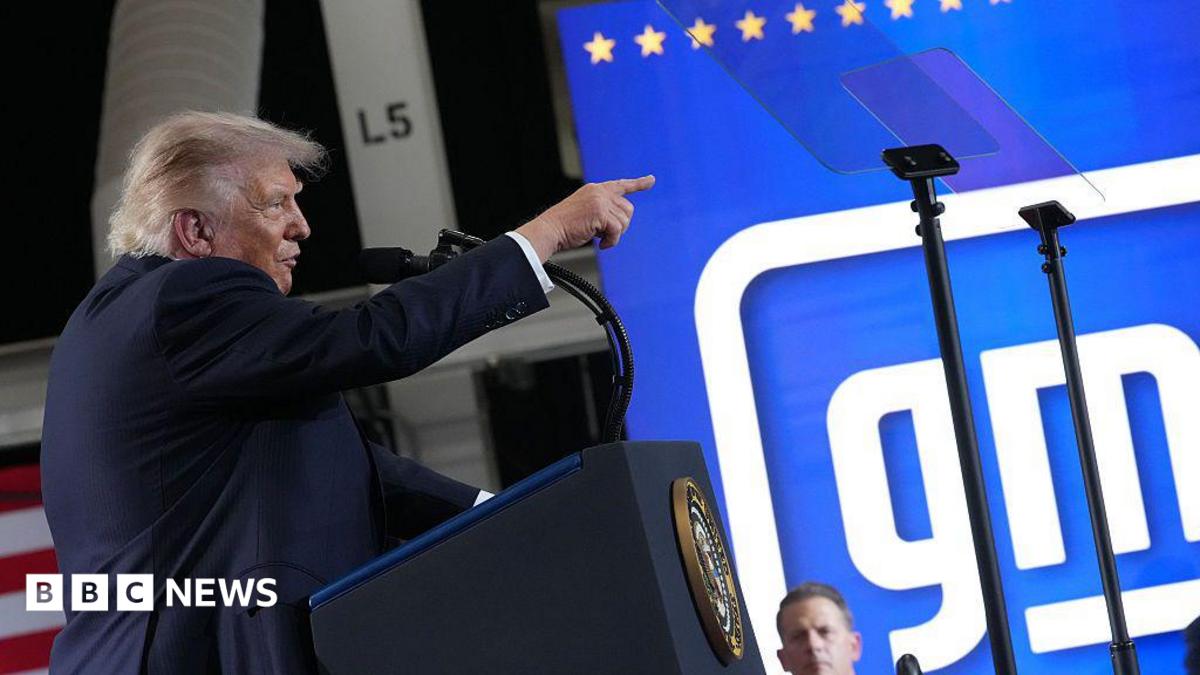
President Donald Trump traveled to Michigan on Monday to vigorously defend his tariff policies at a General Motors plant in Milford, even as the state's job growth has slowed to a crawl and rising costs from the Iran war continue to squeeze households. Speaking to workers and supporters, Trump argued that his tariffs are reinvigorating the auto industry and forcing overseas companies to relocate to the United States, according to BBC News. The visit comes as he ramps up rally-type appearances ahead of the November midterm elections and as a planned increase in tariffs on Canadian goods, including autos, looms in August.
Main Story
President Trump's visit to Michigan on Monday was a full-throated defense of his tariff policies, which have hit the state's crucial auto sector particularly hard. Speaking at a General Motors plant in Milford, Trump claimed that his historic tariffs are reinvigorating the auto industry and forcing companies to relocate their overseas operations to the United States, according to BBC News. The rule, as Trump described it, is straightforward: build vehicles outside the US and pay a fee to sell them in America; build them in Michigan or elsewhere in the US and face no tariff at all.
However, the economic reality in Michigan tells a more complicated story. According to data from the Bureau of Labor Statistics cited by BBC News, Michigan gained just 500 jobs in the 12 months leading up to June 2026, compared to Texas which added 177,900 jobs. The state also has one of the highest unemployment rates in the country. The impact of tariffs, combined with inflation and rising gas prices stemming from the Iran war, has prompted alarm in many communities across Michigan.
Trump also addressed affordability concerns, blaming the problem on the Biden administration, according to NYT Politics. He assured supporters that negotiations over ending the war in Iran, a conflict that has sent fuel and energy prices soaring, are continuing in a friendly fashion.
Tariff Impact on Auto Industry
The tariffs have already begun to reshape North American auto production. Last year, vehicle production fell in all three North American countries, with Canada seeing the largest decline of 5.4%, according to an analysis by TD Bank reported by BBC News. Automakers have started making changes to their production lines. The White House pointed to GM's $6 billion investment in US manufacturing, as well as smaller investments by Ford, Stellantis, and Detroit Diesel, as evidence that Trump's policies are working.
But the tariffs have also strained relations with Canada, a key trading partner for Michigan. A 25% levy on non-US parts on Canadian-assembled passenger vehicles is already in place, along with steel tariffs that indirectly affect the industry. These will only rise if the US follows through with a planned increase to 50% on some Canadian goods, including autos, in August. Canada has responded with 25% tariffs on US vehicles and parts not compliant with the USMCA, according to BBC News.
Political Context
Trump's Michigan visit is part of a broader effort to bolster support for Republican candidates ahead of the November midterm elections. Michigan, a key battleground state that swung back in the Republican Party's favor in 2024, relies heavily on nearby Canada for its economy. The president's rally-type appearances are designed to energize his base and frame the election as a choice between his protectionist policies and the previous administration's approach.
Trump's trip also featured a notable visual: he flew to Michigan on the newly painted Air Force One. According to a pool report from Ana Ceballos of the Los Angeles Times, cited by The Hill, the plane is now dark blue with a gold stripe and red trim, matching the color scheme Trump had previously advocated for.
What Officials and Groups Are Saying
White House officials pointed to GM's $6 billion investment in US manufacturing as evidence that Trump's economic policies are working, according to BBC News. They also highlighted smaller investments by Ford, Stellantis, and Detroit Diesel. However, state officials have noted Michigan's sluggish job growth and high unemployment rate, raising concerns about the effectiveness of the tariff strategy.
Canadian officials have signaled that everything is on the table regarding retaliation, with plans to respond to US tariffs already in motion, as reported by BBC News. The planned increase to 50% on some Canadian goods in August has heightened tensions between the two countries.
Timeline
- 2024: Michigan swings back in favor of the Republican Party in the presidential election.
- 2025-2026: Trump administration imposes a 25% tariff on non-US parts on Canadian-assembled vehicles and steel tariffs.
- 2026: Vehicle production falls in all three North American countries; Canada sees a 5.4% decline.
- July 27, 2026: Trump visits Michigan, defends tariffs, and blames Biden for affordability issues; Iran war negotiations continue.
- August 2026: Planned increase to 50% tariffs on some Canadian goods, including autos, is set to take effect.
Frequently Asked Questions
Why did Trump visit Michigan?
Trump visited Michigan to defend his tariff policies and rally support for Republican candidates ahead of the November midterm elections. The state has been hit hard by tariffs, particularly in the auto sector.
What is the current tariff situation with Canada?
The US has a 25% tariff on non-US parts on Canadian-assembled vehicles and steel tariffs. A planned increase to 50% on some Canadian goods, including autos, is set for August. Canada has retaliated with 25% tariffs on US vehicles and parts not compliant with the USMCA.
How is the Iran war affecting affordability?
The Iran war has sent fuel and energy prices soaring, contributing to inflation and rising costs for households. Trump assured supporters that negotiations to end the war are continuing in a friendly fashion.
What is the state of Michigan's economy?
Michigan gained only 500 jobs in the 12 months leading up to June 2026, one of the lowest rates in the country. The state has one of the highest unemployment rates, despite Trump's claims that tariffs are reinvigorating the auto industry.
What is the new Air Force One paint scheme?
The Air Force One that flew Trump to Michigan now features a dark blue color with a gold stripe and red trim, matching the scheme Trump had previously advocated for.
What Happens Next
As the August tariff increase on Canadian goods approaches, the economic pressure on Michigan and other manufacturing states is likely to intensify. The Iran war continues to drive up energy costs, and negotiations remain ongoing. With the midterm elections just months away, Trump's ability to convince voters that his policies are working will be critical for Republican candidates. The newly painted Air Force One may serve as a symbol of his administration's priorities, but the real test will be whether the promised economic revitalization materializes in states like Michigan.
More from the Domestic Policy desk
 New
New
Idaho In-N-Out Shooting Leaves Multiple Dead, Shooter Among Them
A gunman opened fire at an In-N-Out Burger in Twin Falls, Idaho, killing several and wounding others before dying. Police say…
 New
New
Trump vs. Pirro: Reflecting Pool Feud Entangles Blanche Nomination
President Trump publicly rebukes his own U.S. Attorney Jeanine Pirro over the dropped Reflecting Pool case, as the dispute…
 New
New
Charges Dropped Against Ex-Olympian in Reflecting Pool Case
Federal prosecutors drop felony vandalism charges against former Olympian David Hearn, admitting the Lincoln Memorial…
 New
New
Trump's $1.8B Fund Complicates Blanche AG Nomination
Trump defends $1.8B 'anti-weaponization fund' for Jan. 6 defendants, further complicating Todd Blanche's attorney general…